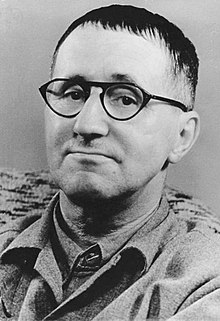
Brecht is well known for his ground breaking, avant-garde approach to contemporary theatre shown in the genre of Epic Theatre. Epic Theatre presents the idea that an audience must see, criticise and connect with the wider political context of the play rather than identifying and connecting emotionally with the characters and the plot. He thought it to be very important that the audience (or spectators as he liked to call them) be aware that the play is a representation of reality and not reality itself by highlighting the manufactured theatrical nature of the play. He employed many different techniques in order to create this effect on his spectators, these techniques come under the umbrella term Verfremdungseffekt or 'defamiliarisation effect' in English.
Verfremdungseffekt
Brecht wanted his spectators to feel this effect, for them to see life and reality from a slightly different perspective. Brecht wrote that this involved 'stripping the event of its self-evident, familiar, obvious quality and creating a sense of astonishment and curiosity about them'. This term encompassed a number of techniques used by Brecht:
Historicisation - setting the action of the play in the past but containing parallels with contemporary events so that the spectators could view the action with emotional detachment from their current lives and therefore respond to the piece in a more political way.
Structure - Epic plays span over a large period of time and many different locations. This large narrative causes the spectators to be unable to gain an emotional attachment for the characters as they only meet them for short periods of time, spaced very far apart. The audience sees the effects of the character's actions and the consequences of their political and social situation. Brecht called scenes 'episodes' and each one was somewhat self contained. The plots were often non-linear and fragmented, creating a montage effect. Writing in the rise of cinema, Brecht was inspired greatly by film, most namely the filmmakers Charlie Chaplin (famous for creating films that contained both slapstick comedy and political messages - similar to Brecht's technique of Spass) and Sergei Eisenstein (a pioneer in the theory of montage who believed that an idea derived from the juxtaposition of two independent shots- or episodes in the case of Brecht).
Gestus - a clear character gesture or movement that shows a specific attitude or social comment rather than a characteristic of the character. Brecht and his actors studied photographs of the plays in rehearsal to ensure each moment worked effectively so that the audience could tell by the actor's gestures alone what was happening and the social and political messages of that scene.
Spass - literally translated as 'fun', Brecht thought it important to send his messages through comedy as he believed that when an audience is laughing they are thinking too. 'Spass' also breaks the tension of a play and through breaking rising tension of the plot, the audience are less likely to become attached to the characters and ignore the political motives of the play.
Stagecraft - one of the most well-known elements of Brecht's stagecraft was his use of placards to show the audience a range of information, sometimes to remove the suspense and element of unknown so the spectators can be distanced from the action and focus on the context of the piece. Costume and set was often incomplete and fragmentary, displaying just enough so that the audience would understand the role of the character and the place of the setting but not be realistic. For example an actor may wear a tie and hold a briefcase to show that he is a businessman and a corner of a table and a single chair would show they are in a dining area. Costume often denoted the role of a character within society and their wealth/class. Often sets would be lit with white light only as colour would evoke emotion in the spectators. If musicians were used in the piece they would be lit in full view of the audience in order to remind the audience once again that they are watching a play.
Characters - Characters tended to be somewhat over simplified and stereotyped but they weren't limited to this idea; some characters could be more complex and realistic. Some names of the characters are generic (e.g. the worker, the farmer) to clearly show their role in society rather than a real human character that one can connect with.
Music and Song - songs were used to distance the audience from the action of the play and they would often express the plays themes but out of context from the action of the play. It was used to neutralise emotion rather than intensify it.
Music and Song - songs were used to distance the audience from the action of the play and they would often express the plays themes but out of context from the action of the play. It was used to neutralise emotion rather than intensify it.
Comments
Post a Comment